三菱日联金融集团(MUFG)是日本最大的金融集团之一,以三菱日联银行为核心。通过银行、信托银行、证券、信用卡、租赁等金融服务,MUFG 为日本及全球的个人和企业提供支持。
对于 MUFG 而言,人工智能不仅仅是提高效率的工具。该公司将其视为拓展人类思维和创造力的一种方式,帮助员工和人工智能在共同构建更好的金融服务的过程中相互学习。为了推进这一愿景,MUFG 正与 OpenAI 合作,在三菱日联银行推广 ChatGPT Enterprise,并打造全新的人工智能驱动的客户体验。
2024 年 10 月,MUFG 开始与 OpenAI 合作,利用生成式 AI 实现金融业务现代化并提高效率。从 2026 年开始,三菱日联银行分阶段推广 ChatGPT Enterprise,使约 35,000 名员工能够在日常工作中使用它,MUFG 也继续朝着成为一家 AI 原生公司的目标迈进。
与 OpenAI 共同打造 AI 原生基础
MUFG 正在构建使 AI 成为日常工作一部分的系统、环境和文化。其转型结合了领导层自上而下的承诺与员工在日常工作中使用 AI 的自下而上的赋能。
“我相信 AI 将从根本上改变金融的本质,”MUFG 集团首席数字转型官 Tadashi Yamamoto 表示。“为了将 AI 快速引入组织,建立一个让每位员工都能自然使用 AI 的环境和文化至关重要。”

OpenAI 成为 MUFG 实现这一转变的首选合作伙伴。Yamamoto 将 OpenAI 描述为从服务设计到实施全程亲力亲为的合作伙伴,帮助 MUFG 同时追求客户服务创新和银行业务转型。
“OpenAI 与我们共享成为 AI 原生公司的愿景。凭借其前沿技术和模型,我们看到了一个能够帮助我们将该愿景变为现实的合作伙伴。”
Tadashi Yamamoto,MUFG 集团首席数字转型官
该计划的核心部分之一是在全行范围内推广 ChatGPT Enterprise。三菱日联银行董事总经理兼人工智能与解决方案部门负责人 Kohei Shimano 表示,决定因素是广泛的适用性和安全性。许多员工已经熟悉 ChatGPT,而企业级安全性使得在满足金融机构所需的管理和治理要求的同时推广该工具成为可能。
“我们的目标是创造一个 AI 不仅仅是少数专家使用的工具,而是每位员工在日常工作中都能像伙伴一样使用的世界,”Shimano 说。他补充说,OpenAI 与 MUFG 就安全要求进行了合作,通过产品改进和更新提供了具体建议,以解决可能阻碍推广的安全和治理障碍。
帮助员工自信地使用 AI
随着 MUFG 推广 ChatGPT Enterprise,仅提供访问权限并不会产生影响力。员工需要了解何时以及如何使用该工具,将其融入工作,并自信地使用它。作为一家金融机构,MUFG 还需要明确的信息管理流程、审批路径以及员工能做什么和不能做什么的规则。
OpenAI 从引入到采用全程支持了此次推广。这包括企业使用指南、运营规划、产品教育、面向所有员工的培训计划、自定义 GPT 研讨会以及高管学习课程。MUFG 还将 AI 培训设为强制性要求:员工必须先完成在线学习,才能使用 ChatGPT Enterprise。
“障碍不在于技术本身,”Shimano 说。“它存在于组织内部。人们不知道如何使用它,也不知道可以用它来做什么。通过充分利用 OpenAI 提供的培训计划,我们创造了一个良性循环,越来越多的员工开始使用它,采用率也随之提高。”
三菱日联银行人工智能与解决方案部门副总裁 Sayuri Yonese 表示,OpenAI 的支持帮助 MUFG 为员工自行扩展 AI 使用奠定了基础。OpenAI 提供了自定义 GPT 培训材料、银行业特定示例以及大规模推动采用的最佳实践。随后,MUFG 在每个部门任命了 AI 倡导者。这些 AI 倡导者不依赖单一的中央团队,而是鼓励同事尝试 AI,并帮助从每个业务领域内部扩大使用范围。
这种转变在内部对话中显而易见。早期的讨论通常集中在诸如“我们可以用 AI 做什么?”和“我们甚至被允许使用它吗?”等问题上。如今,对话已转向“我们应该如何使用它?”和“我们下一步应该将其应用于何处?”

成果概览
自 MUFG 开始向三菱日联银行约 35,000 名员工推广 ChatGPT Enterprise 以来,整个组织已出现早期采用和影响的迹象。
- 获得账户的员工培训参与率达到 100%,强制性在线学习有助于建立安全、有效使用的共同标准。
- 在 OpenAI 主导的自定义 GPT 培训之后,员工在四个月内创建了超过 1,800 个自定义 GPT,表明团队已开始将 AI 嵌入日常工作流程。
- 在选定的研究任务中,例如跟踪 AI 趋势并为高管和内部利益相关者准备更新报告,员工报告工作量减少了 20-30%。
在整个银行范围内,员工还创建了许多内部称为“AI 银行家”的自定义 GPT。每个部门的员工根据自身工作流程定制这些 AI 银行家,用于简化耗时的任务,并使曾经依赖特定个人的专业知识在整个组织中更易于获取。
Yonese 将 AI 银行家描述为员工的支持者。“它们帮助我们的员工专注于创造更大价值的工作,以及能为客户带来更好价值的工作,”她说。
然而,对于 MUFG 而言,AI 的真正价值不仅仅是减轻工作量。而是将节省的时间重新投入到客户拜访、更有力的提案以及仍由人类负责的决策和审批中。通过使用 AI,员工可以更专注于只有人类才能完成的工作,并花更多时间直接与客户互动。这一理念正是 MUFG AI 原生转型的核心。
通过 AI 重塑金融服务
三菱日联金融集团与 OpenAI 的合作并未止步于内部转型。该公司还在探索 AI 如何改变客户发现金融服务、寻求建议以及采取行动的方式。
其中一个例子是财富管理应用 Moneytree。通过 ChatGPT 中的应用程序,用户将能够在 ChatGPT 内用自然语言提问,并查看账户余额和交易明细等信息。该体验可利用后续问题整理相关信息,并以对话形式使其更易于理解。
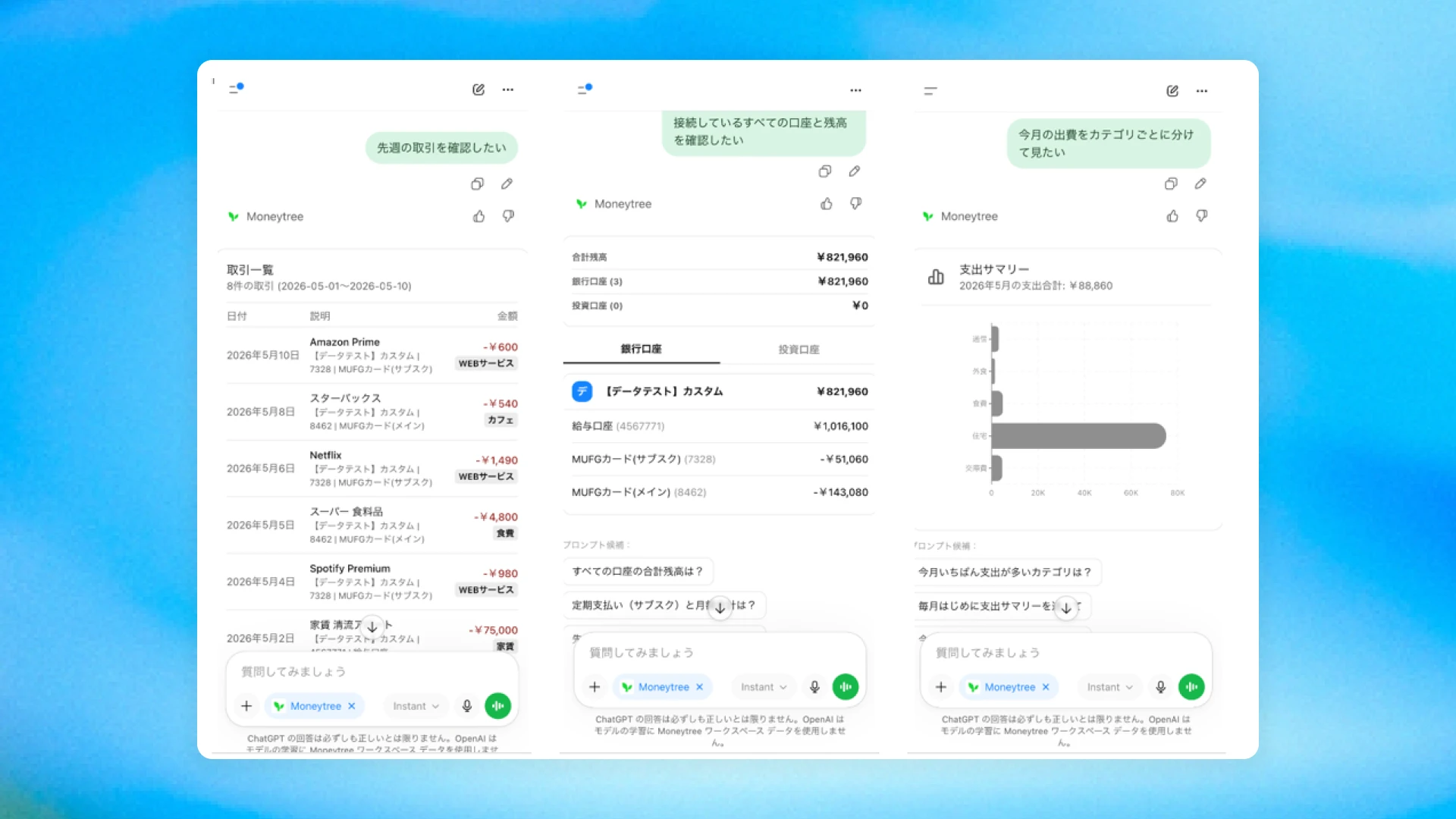
*所示界面和功能仅供说明,可能发生变更。
在提供机器人顾问服务的 WealthNavi,一个专门的 AI 组织正在建立,与 OpenAI 的合作也在推进中。基于该公司率先实现全自动资产管理的努力,WealthNavi 正寻求借助 AI 进一步加速这一进程。
作为这些努力的一部分,三菱日联金融集团(包括 WealthNavi)计划在其综合金融服务品牌 emutt 旗下的数字银行中使用 OpenAI 技术。具体而言,它正准备实施一个 AI 管家,通过与客户的对话让金融服务更易获取,以及 MAP(货币咨询平台),一个旨在根据每位客户的人生阶段提供个性化推荐的综合咨询平台。
“我们希望提供全天候的金融服务,不受时间或地点的限制,”山本表示。“在数字银行中,我们希望提供只有 AI 才能实现的个性化推荐。”
三菱日联金融集团正超越以银行应用和网点为中心的传统体验,迈向一个人们可以通过与 AI 的日常互动,从金融指导自然过渡到交易的未来。通过其数字银行,三菱日联金融集团旨在将 AI 原生金融带给更多客户。
MUFG is one of Japan's largest financial groups, with Mitsubishi UFJ Bank at its core. Through banking, trust banking, securities, cards, leasing, and other financial services, MUFG supports individuals and businesses in Japan and around the world.
For MUFG, AI is more than an efficiency tool. The company sees it as a way to extend human thinking and creativity, helping employees and AI learn together as they build better financial services. To advance that vision, MUFG is working with OpenAI to roll out ChatGPT Enterprise across Mitsubishi UFJ Bank and create new AI-powered customer experiences.
In October 2024, MUFG began working with OpenAI to modernize financial operations and improve efficiency with generative AI. Beginning in 2026, Mitsubishi UFJ Bank began a phased rollout of ChatGPT Enterprise so that approximately 35,000 employees could use it in their daily work, as MUFG continues its journey toward becoming an AI-native company.
Building an AI-native foundation with OpenAI
MUFG is building the systems, environments, and culture that make AI part of everyday work. Its transformation combines top-down commitment from leadership with bottom-up enablement for employees using AI in daily workflows.
"I believe AI will fundamentally change the nature of finance," says Tadashi Yamamoto, Group CDTO at MUFG. "To bring AI into the organization quickly, it is important to have an environment and culture where every employee can use AI naturally."
OpenAI became MUFG's partner of choice for that shift. Yamamoto describes OpenAI as a hands-on partner from service design through implementation, helping MUFG pursue both customer-service innovation and banking transformation.
“OpenAI shared our vision of becoming an AI-native company. With its frontier technology and models, we saw a partner that could help us turn that vision into reality.”
Tadashi Yamamoto, Group CDTO, MUFG
One core part of the initiative is the bank-wide rollout of ChatGPT Enterprise. Kohei Shimano, Managing Director and Head of the Artificial Intelligence and Solutions Department at Mitsubishi UFJ Bank, says the deciding factors were broad applicability and secure use. Many employees were already familiar with ChatGPT, and enterprise-grade security made it possible to roll out the tool while meeting the management and governance requirements expected of a financial institution.
"We are aiming for a world where AI is not a tool used only by a small number of experts, but something every employee can use in daily work, almost like a partner," Shimano says. He adds that OpenAI worked with MUFG on security requirements, offering concrete proposals through product improvements and updates to address security and governance barriers that could otherwise have slowed the rollout.
Helping employees use AI with confidence
As MUFG rolled out ChatGPT Enterprise, access alone would not create impact. Employees needed to understand when and how to use the tool, incorporate it into their work, and use it with confidence. As a financial institution, MUFG also needed clear processes for information management, approval routes, and rules for what employees could and could not do.
OpenAI supported the rollout from introduction through adoption. This included guidance for enterprise use, operational planning, product education, training programs for all employees, custom GPT workshops, and executive study sessions. MUFG also made AI training mandatory: employees had to complete e-learning before they could use ChatGPT Enterprise.
"The blocker was not the technology itself," Shimano says. "It was inside the organization. People did not know how to use it or what they were allowed to use it for. By making full use of the training program OpenAI provided, we created a positive cycle where more employees started using it and adoption increased."
Sayuri Yonese, Vice President, Artificial Intelligence and Solutions Department at MUFG Bank, says OpenAI's support helped MUFG create a foundation for employees to expand AI use on their own. OpenAI provided custom GPT training materials, banking-specific examples, and best practices for driving adoption at scale. MUFG then appointed AI champions in each department. Rather than relying on a single central team, these AI champions encourage colleagues to experiment with AI and help expand usage from within each business area.
That shift is visible in internal conversations. Earlier discussions often centered on questions like, "What can we use AI for?" and "Are we even allowed to use it?" Today, the conversation has moved toward, "How should we use it?" and "Where should we apply it next?"
Results at a glance
Since MUFG began rolling out ChatGPT Enterprise to approximately 35,000 employees at Mitsubishi UFJ Bank, early signs of adoption and impact are emerging across the organization.
- Training participation among employees receiving accounts reached 100%, with mandatory e-learning helping establish shared standards for safe, effective use.
- After OpenAI-led custom GPT training, employees created more than 1,800 custom GPTs in four months, showing that teams were starting to embed AI in daily workflows.
- In selected research tasks, such as tracking AI trends and preparing updates for executives and internal stakeholders, employees reported a 20-30% reduction in workload.
Across the bank, employees have also created many custom GPTs known internally as “AI bankers.” Employees in each department tailor these AI bankers to their own workflows, using them to streamline time-consuming tasks and make specialized knowledge that once depended on specific individuals more accessible across the organization.
Yonese describes AI bankers as supporters for employees. “They help our employees focus on work that creates greater value and on the work that leads to better value for our customers,” she says.
For MUFG, however, the true value of AI is not simply reducing workload. It is about reinvesting the time saved into customer visits, stronger proposals, and the decisions and approvals that remain the responsibility of people. By using AI, employees can focus more on work only humans can do and spend more time engaging directly with customers. That idea lies at the heart of MUFG’s AI native transformation.
Reimagining financial services through AI
MUFG and OpenAI's work does not end with internal transformation. The company is also exploring how AI can change the way customers discover financial services, seek advice, and take action.
One example is Moneytree, a wealth management app. Through Apps in ChatGPT, users will be able to ask questions in natural language from within ChatGPT and view information such as account balances and transaction details. The experience can use follow-up questions to organize relevant information and make it easier to understand in a conversational format.
*Interface and functionality shown are illustrative and subject to change.
At WealthNavi, which provides robo-advisory services, a dedicated AI organization is being established and collaboration with OpenAI is moving forward. Building on the company’s efforts to pioneer fully automated asset management, WealthNavi is now seeking to accelerate that journey further with AI.
As part of these efforts, MUFG, including WealthNavi, plans to use OpenAI technology in the digital bank at the center of emutt, its integrated financial services brand. Specifically, it is preparing to implement an AI concierge that makes finance feel more accessible through conversations with customers, as well as MAP (Money Advisory Platform), a comprehensive advisory platform designed to deliver personalized recommendations tailored to each customer’s life stage.
“We want to provide financial services 24/7, without the constraints of time or place,” Yamamoto says. “In the digital bank, we want to deliver personalized recommendations that only AI can make possible.”
MUFG is moving beyond the conventional experience centered on banking apps and branches toward a future where people can move naturally from financial guidance to transactions through their everyday interactions with AI. Through its digital bank, MUFG aims to bring AI-native finance to more customers.
本文内容采集自官方网站,排版和翻译可能与原页面存在差异。
阅读官方全文